

If you’re reading this, there’s a good chance you’re feeling it: demand is up, lead times are tight and the production window didn’t magically get longer just because orders did.
That’s one of the most common reasons manufacturers in the Midwest and beyond call us at Envision Automation. They’re often looking for more output in the same time, fewer headaches on the floor and fewer moments where the whole line is standing still while everyone stares at one problem station.
Here’s the part that surprises people: most of the losses associated with lost efficiency or downtime are small issues which add up, including slow load/unload, inconsistent part flow, shift-to-shift variation, little stoppages that happen 50 times a day. Those small losses stack until the shift ends and you’re staring at the numbers wondering where the time went.
This is where the right automation partner makes a difference.
The Most Common Reason Manufacturers Call Envision: Demand Went Up
When volumes rise, manufacturers typically try a few things first:
- Add overtime
- Add people
- Add another shift
- Ask the line to “go faster”
Sometimes that works for a while. But eventually you hit the wall: the bottleneck station. The station that caps everything behind it.
If the limiting station can only do 10 parts per minute, speeding up the steps after it doesn’t change the reality that the line is still stuck at 10 per minute. In manual environments, you can sometimes “catch up” by throwing people at downstream tasks. In automated environments, the bottleneck is the bottleneck, and the only way out is to address it directly.
That’s where a solid integration and automation plan starts: identify the real constraint, then build around it.
What ‘Efficiency’ Means on the Floor
A lot of people talk about efficiency like it’s one thing. We like to frame it as Operational Efficiency (OE), your real output compared to what “100% efficient” would look like.
That “100%” number might be based on a benchmark rate; sometimes it’s the best operator baseline, sometimes it’s a proven cycle time, sometimes it’s the best-case process rate.
OE gets hit by more than machine speed
Even if a machine is capable of running fast, OE gets dragged down by factors like:
- Operator load/unload pace
- Part availability
- Consistency (operator behavior plus part-to-part consistency)
- Process timing drift (small changes that turn into missed cycles)
This is why you can see a machine run 98% OE on 1st shift and then drop to ~75% on 2nd shift, not because the machine changed, but because the system around it changed.
Envision’s goal: reduce the things that restrict OE
Our job as integrators is to design systems that don’t fall apart when challenges show up.
One example concept we use often is buffering/queuing parts so the machine stays fed, even if an operator slows down for a moment, even if parts arrive inconsistently, even if someone gets pulled away for two minutes.
Those two minutes don’t sound like much, until they happen 10 times per shift.
When the system is designed to absorb small variation, OE goes up without anyone having to “work harder” to keep it there.
The Hidden Stuff You Don’t See on a Report
When people say downtime, they often picture a hard stop: a motor failed, the line is down, maintenance is sprinting.
That’s real downtime. But the bigger story is usually:
- Micro-stops
- Slow cycles
- Sensor waits
- Inconsistent loading
- Timing drift
- Components that are “kind of failing,” but not enough to trigger a full fault yet
Those are the losses that quietly steal production all day.
So the question becomes: How do you design equipment and controls to reduce those losses and detect drift before it becomes a failure?
The #1 Controllable Lever for Reducing Downtime: Maintenance
Here’s the simplest analogy we use:
Preventive maintenance is “change the oil.”
Breakdown maintenance is “change the engine.”
A lot of downtime is avoidable if you can keep components healthy (preventive service instead of waiting for failure) and detect performance drift early (before your parts go out of spec or the system crashes).
That detection piece matters more than most teams realize, especially in production environments where tolerances are tight and consistency is everything.
How Envision Designs Machines & Controls to Prevent Downtime
1. Build consistency into the process (not just speed)
A major hidden driver of downtime is inconsistency:
- Parts aren’t always presented the same way
- Loading changes from operator to operator
- Timing varies slightly from cycle to cycle
- Upstream flow isn’t stable
We design around that reality by focusing on stable part flow, predictable loading and controls logic that doesn’t depend on “perfect” human rhythm to hit rate.
2. Add operator messaging that makes slowdowns obvious
When something isn’t moving, the worst situation is: nobody knows why.
We like to build in operator messaging that shows what the machine is waiting for:
- A sensor input
- A part-present confirmation
- A step completion
- A safety condition
- A sequence requirement
That means the floor can diagnose issues in real time instead of guessing. Less guessing = less downtime.
3. Add fault messaging that spots ‘slow failure’ before it becomes a hard stop
A lot of components don’t fail instantly; they get slower. They drag. They start reacting late.
We build fault diagnostics that can track things like:
- Sensor reaction time
- Cylinder extend/retract time
- Motion timing windows
- Delays caused by air/hydraulic pressure loss
- Voltage dips
- Part-present sensor inconsistencies
If a cylinder is extending slower than normal, that can be early warning: drag, wear, contamination, a bearing starting to go, something that’s still “working,” but trending toward a future shutdown.
In certain environments (automotive-style is a common example), data tracking can reveal tolerance shifts before parts go out of spec. That allows teams to intervene early, adjust, service and keep production stable.
Safety & Ergonomics: Sometimes Automation is About Protecting People
Another major “why they call” theme: ergonomics, safety and injury prevention.
Repetitive work or awkward positioning not only hurt people but they create staffing instability, training churn and inconsistent throughput.
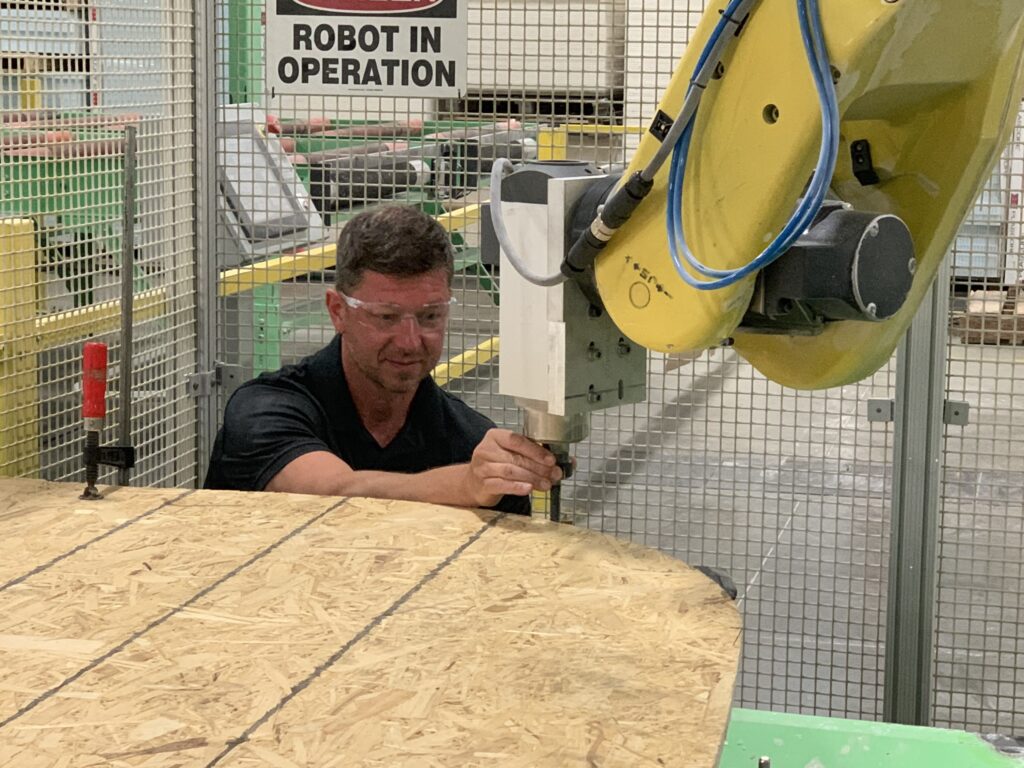
A real-world example we’ve seen: an auto-drill machine project eliminated an overhead manual drilling task after three rotator cuff injuries in under six months. Our automation removed an unsafe motion and freed up three people to shift into assembly and help boost output.
That’s what good automation does: it protects people and makes the production system less fragile at the same time.
Doing More with Fewer People (Without Burning Out Your Team)
Hiring and retention aren’t getting easier. Many manufacturers are trying to keep output steady with fewer hands on the floor.
Automation and system integration can help by:
- Reducing manual touchpoints
- Minimizing rework and inconsistency
- Keeping machines running through buffering and smart flow design
- Turning one operator into a “cell manager” instead of a constant loader/unloader
We’re focused on helping customers put people where they add the most value and building a system that doesn’t collapse when staffing is thin.
What Partnering with Envision Looks Like
Most customers already know their bottleneck. They’ve usually built the product and process manually first. They’ve lived with the pain long enough to point at the exact station and say, “That’s the problem.”
Our role is to help you get to:
- Faster throughput
- Better accuracy
- More consistency
- Fewer people required at the pinch points
The honest constraint: budgets can push the wrong solution
A common challenge we see is when budget pressure leads companies to request fixes that don’t address the limiting station.
If the bottleneck stays capped, the line stays capped. It doesn’t matter how fast the non-limiting steps become.
A good automation partner will tell you the truth early, even if it means rethinking the plan.
Remote support and service: faster troubleshooting, less disruption
We include and quote remote access on most Envision-built machine projects because it changes the speed of support dramatically.
The cost of remote access is often comparable to one initial service call, especially once you factor travel time. But the difference is:
- Troubleshooting can start fast
- Small fixes can be handled quickly
- You reduce the time you’re waiting for someone to arrive on site
We also include one year of support after building a new machine. And in many situations, remote support helps resolve issues fast enough that the disruption (and the billing) stays minimal.
Ready to Improve OE & Reduce Downtime? Let’s Talk.
Schedule an Automation & Integration Consult
If your demand is climbing, your bottleneck is obvious or downtime is eating your week, we can help you map a practical path forward, from single-station improvements to a fully integrated system.
Contact Envision Automation to:
- Identify bottlenecks and OE restrictions
- Review your current process and constraints
- Explore automation concepts that fit your reality and budget
- Build systems with diagnostics that reduce downtime long-term
Want a faster response when problems pop up? Ask about remote support.
If we build it, we can usually troubleshoot it quickly, with remote access designed into the project.